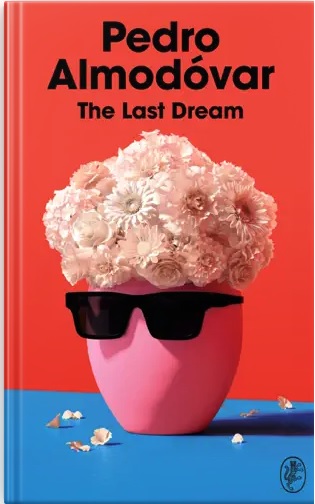
The films directed by Pedro Almodóvar were my first contact with Spanish cinema. I started to learn Spanish at the time, so it was a double pleasure for me – I could get to know the films of the famous film director and to listen to the dialogues in original (Spanish) language. His films gave me a great opportunity to get to know many actors – and some of them I could see in different artistic creations, as they appeared in more than just one film. So it was interesting to follow not only the director’s subsequent films, but also the actors’ creations. And knowing Spanish allowed me to follow articles in Spanish newspapers and portals, and to compare how Almodóvar’s films were received in Spain and in Poland. His scripts were sometimes controversial and there are films that I have only watched once and will not return to them. However, I was always looking forward to his next films with great curiosity.
A similar curiosity came when I heard about Pedro Almodóvar’s book „The Last Dream”. However, even though it was published in 2023, I only read it recently. Sometimes it’s like this with books – you have to wait with reading for the right moment (and mood).
The book is a bit perfidious, as indeed is all of Pedro’s work, that constantly surprises the viewer. The cover alone catches the eye and seems to me to be very apt and full of distance. Seeing Almodóvar’s ‘face’ on the cover, we expect an autobiography. And already in the introduction Pedro writes that nothing of the sort. There will be no autobiography. But there will instead be the short stories he has been creating throughout his life. Are you disappointed and at this point say that since it is short stories you are not interested in reading after all? Keep calm. I can assure you that these stories are in fact autobiography, but … not typical one. After all, Pedro Almodóvar is not a typical director either. The book is a collection of many interesting short stories, which we can most simply divide into realistic and fantastic. There are stories that are strictly autobiographical, but there are also stories that make us wonder who the real protagonist is. Do we know him or her? Maybe from Almodóvar’s films?
Of course, as in every case, we will like some stories more than others. Some will stay in your memory for a long time, others will “evaporate” immediately after reading. I admit that what surprised me the most was that each one made me think, reminisce or look for associations with the films directed by Pedro Almodóvar that I had watched. That’s why I “dosed” my reading and read one story at a time, so that the “background application” running in my brain had time to reflect on the new story.
The book was translated into Polish by two translators: Agata Ostrowska and Katarzyna Okrasko. While in the case of novels I would be skeptical about translating the text by more than one person (each author or translator has its own unique style), here I was very positively surprised by the final effect. I think the reason why despite two translators responsible for the work the result turned out coherent was the fact that these are separate stories and were created by Pedro at different moments in his professional and personal life.
I recommend the book to both fans of Almodóvar’s film work and those who have just heard about him for the first time. And for those who learn/know Spanish, I recommend reading the original version (or versions: your native language and Spanish language simultaneously, like Tom Hanks in “The Terminal” – I also recommend this film: ).