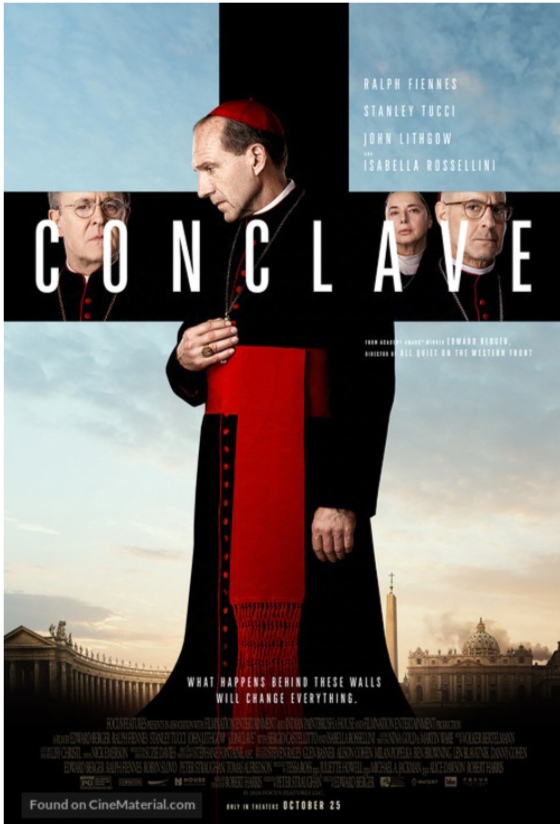
When I saw the poster advertising the film „Conclave”, directed by Edward Berger, I knew it would be a film I would have to watch. Where did this certainty come from? Maybe I thought that if someone decides to make a film about the Catholic Church, it will be worth watching? Maybe the name of the director (who directed, among others, „All Quiet on the Western Front”? Maybe the long list of great actors who took part in this project? Or maybe all above plus my „film intuition”? 🙂 The fact is that watching „Conclave” was a very good decision and I will briefly tell you why (don’t worry, I won’t reveal too many details).
As the title suggests, the plot of the film concerns a conclave called after the death of the Pope. Cardinals from all over the world come to the Vatican to elect a new leader of the Church. The deliberations are led by Cardinal Lawrence (Ralph Fiennes), whose responsibility is to oversee their smooth conduct. However, when such a high stake as the election to become a Pope, even cardinals forget about the rules of fair play, which leads to many surprising scenes for the viewer.
Was the plot of this film a surprise to me? Unfortunately, no. I think that for anyone interested in what is happening in the world and what sins the church has on its record, the content included in the film „Conclave” will not be a surprise. There was not a single moment when I thought that something like this could not have happened in the Vatican.
And was I surprised by how this film was constructed, what themes emerged and how they were presented? Definitely yes, but in a very positive way. The film is coherent, it surprises until the very end, and at the same time leaves the viewer with a few question marks. It is watched like a very good thriller and the viewer constantly wonders what will happen next, in which direction the scriptwriter will steer the story. I was wondering to what extent this conclave presented in the film is close to any of the conclaves that took place in reality. Or is it the accumulation of the behavior of its participants over the years?
The film shows the sinful side of the church, the lack of a self-correction mechanism and how the desire to gain the greatest possible power changes a person (or maybe it only reveals the person’s real personality)? Intrigues, secrets from the past, treating nuns like cleaners, cooks, waitresses, and at the same time faith and obedience to the Ten Commandments. Is this the right setting for electing a pope?
In addition to the aforementioned Ralph Fiennes, the film also features great actors: Stanley Tucci (who, despite many roles, is still often associated as „the one who played in “The Devil Wears Prada”), John Lithgow, Sergio Castellitto, Isabella Rossellini, Jacek Koman and Carlos Diehz, making his feature film debut. In addition to a very good script, cinematography, and acting, an important role in the film „Conclave” is played by the music by Volker Bertelmann (who also composed the music for the film “All Quiet on the Western Front”). All the elements fit together perfectly, which makes you watch the film with great engagement ntil the very last minute.
Let me finally add that for me this is not just a film about electing a pope and the church. It is a film about power and what people, mortals are willing to do to gain this power. After all, as the film’s Cardinal Bellini (played by Stanley Tucci) says: “everyone wants to be pope”. Let’s keep this in mind when following the omnipresent political election campaigns, as well as in our smaller, professional (and not only) communities. And remember, sometimes voting for yourself can be risky. Why? Watch „Conclave”, you will find the answer 🙂